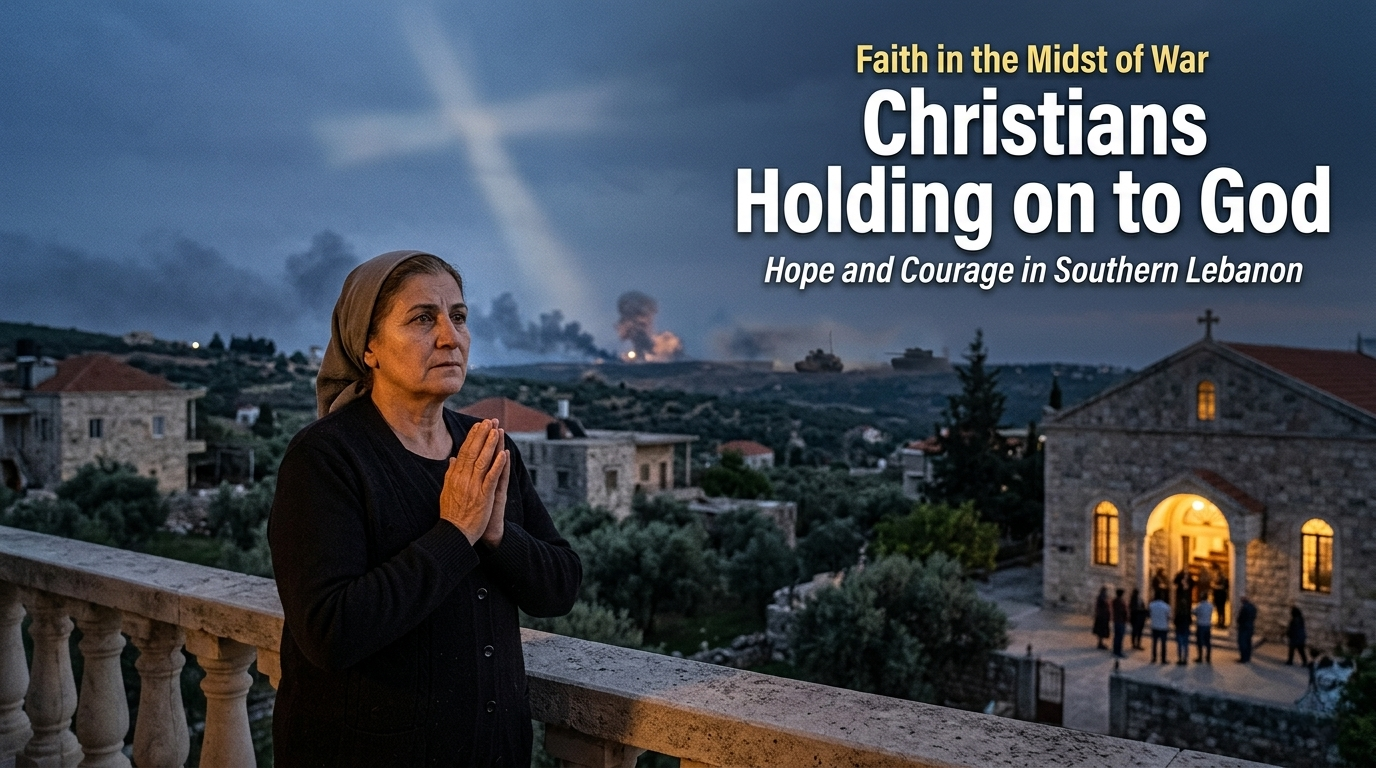
On Monday night, a Christian mother in southern Lebanon lay awake as the sounds of gunfire and explosions echoed through the darkness. The renewed conflict between Israel and Hezbollah had entered its second day, and once again war had reached the doorstep of her village.
Only two kilometers from the Israeli border, the small Christian village of Deir Mimas has long stood on the front lines of regional conflict. Though the villagers are not affiliated with Hezbollah and know they are not intentional targets, the fear and uncertainty of war still weigh heavily on their hearts.
For this 56-year-old mother whom we will call Micheline for security reasons the night was filled with prayer. Like many believers in the region, she has learned that in times of instability, faith in God becomes the only true refuge.
The next morning, as she stood on her balcony, Micheline called a neighbor across the street. The neighbor was preparing to welcome a new grandchild, and Micheline wanted to check on her. The neighbor’s home stood next to the house of an Orthodox priest.
As the two women spoke on the phone, a sudden explosion shattered the moment. An Israeli tank shell struck both houses.
“I saw the fire and the smoke right in front of my eyes,” Micheline recalled.
Through the phone, she heard her neighbor screaming before the call ended. Miraculously, the neighbor was unharmed, though the priest’s son was injured and later taken to the hospital by the Lebanese Red Cross.
Though Micheline does not know why the homes were hit, the event is a sobering reminder of the dangers Christians face in southern Lebanon. Nearby villages with large Christian populations have also suffered casualties, including the death of a Maronite priest in the village of Qlayaa.
Since early March, Israel and Hezbollah have once again entered a large-scale conflict—one connected to the broader tensions involving Israel, Iran, and the United States. Hundreds of thousands across Lebanon have been displaced. Yet in the south, many Christians have chosen to remain in their homes despite the fighting.
Shortly after the shelling, Micheline, her husband, and their son gathered their belongings and moved to her sister-in-law’s house in the center of the village, hoping it would be safer.
It was not the first time.
In fact, it was the fifth time in her life that war had forced her family to flee.
The last displacement occurred during the war of 2024, when they temporarily moved to Beirut. This time, however, they have chosen to remain in Deir Mimas. Financial limitations, love for their land, and concern for their home make leaving even more difficult.
During the previous conflict, Israeli troops entered the village and occupied several homes including Micheline’s.
“They damaged everything,” she said. “They made the house dirty and took many things. It was heartbreaking.”
When a cease-fire allowed them to return later that year, the family repaired what they could and tried to rebuild their lives.
But remaining in the village still comes with daily risks. Rockets often fly overhead, and once an interceptor missile landed on the roof of a house only 50 meters away. Electricity has also been cut, forcing residents to rely on generators and solar power.
Yet amid the uncertainty, Micheline has found renewed strength in her faith.
Last Friday evening, she joined about forty believers both Catholics and Orthodox Christians at Saint Michael Church for a Lenten service. Among those present was the same priest whose home had been shelled, along with his son who had recently returned from the hospital.
Even as distant explosions echoed outside, a deep sense of peace filled the church.
Together they prayed, sang, and read from the Psalms.
One passage spoke powerfully to Micheline’s heart Psalm 91, which declares God as a refuge and protector in times of trouble.
“A thousand may fall at your side, ten thousand at your right hand, but it will not come near you.”
“Every time I read it, I feel surrounded by God’s power,” she said. “But this time I felt His presence even more deeply as if He was embracing us.”
Not every believer remained in the village.
Pastor Maroun Shammas of the Baptist Church of Deir Mimas decided that, with a newborn baby and elderly relatives in his family, it was wiser to temporarily evacuate. After a difficult journey through roads threatened by bombings, his family eventually reached a seminary near Beirut that had opened its doors to displaced families.
Though the place offered safety, it also reminded him of how painful displacement can be.
“When we arrived, we had mixed feelings,” Pastor Shammas said. “We felt grateful to be in a safe place, but leaving your home the place filled with your memories is never easy.”
It was the eighth time war had forced him to leave.
Still, his hope remains firm.
“We pray this will be the last time,” he said. “We long to return to the place where we love and where we serve God.”
Another pastor, Najib Khoury of the Marjayoun Evangelical Baptist Church, made the opposite choice.
After returning from Switzerland, where he had attended the birth of his grandchild, he traveled back to his village near Deir Mimas despite warnings from others.
People told him he was crazy to go back.
But he answered simply:
“My heart is here. I’m not a hero I just love this place.”
Shortly after arriving, he gathered about twenty-five believers in his church for a Bible study. Explosions sounded in the distance as they worshiped and sang hymns.
At one point during the service, Pastor Khoury became overwhelmed with emotion.
He had been thinking about a shepherd he saw in Beirut the night before a man who had walked for days with his flock to protect them during the war.
“If a shepherd would not leave his sheep behind,” he said, “how could I leave mine?”
For Pastor Khoury, the church is his flock, and he feels called by God to remain with them.
Like many believers in the region, he also draws comfort from Psalm 91, which has become something of a spiritual banner for the church since earlier conflicts.
“I am holding on to God’s promise,” he said. “And I encourage the church to hold on to it as well.”
Farther south, in the village of Rmeich, Christians face similar challenges. Many neighboring towns lie in ruins after previous conflicts, leaving the village isolated.
Still, residents have chosen to remain.
Some fear that if the town is abandoned, it could be used as a base for militant activity, placing it in even greater danger.
For believers like Emanuela Tini, a Romanian Christian who has lived in the area for decades, the cost of war has already been devastating. Two years ago, an airstrike destroyed the home she and her husband had spent twenty years building.
She sold her gold to help rebuild it.
They finished the reconstruction only months ago.
“We are so tired of war,” she said quietly.
Yet despite the hardship, she believes God has placed her there for a reason.
Rmeich is not just her home it is her ministry.
She serves in her church by helping with administration, cleaning, cooking, and visiting local families to share the gospel.
At one point she asked God why He had placed her in such a difficult place.
“But then I understood,” she said. “God needs me here.”
In the midst of war, displacement, and uncertainty, the Christians of southern Lebanon continue to hold tightly to their faith believing that even in the darkest moments, God remains their refuge, their protector, and their hope.