The Trump-Xi Beijing summit of May 2026 showed two superpowers trying to manage rivalry politely. But what does this moment look like through a Christian lens?

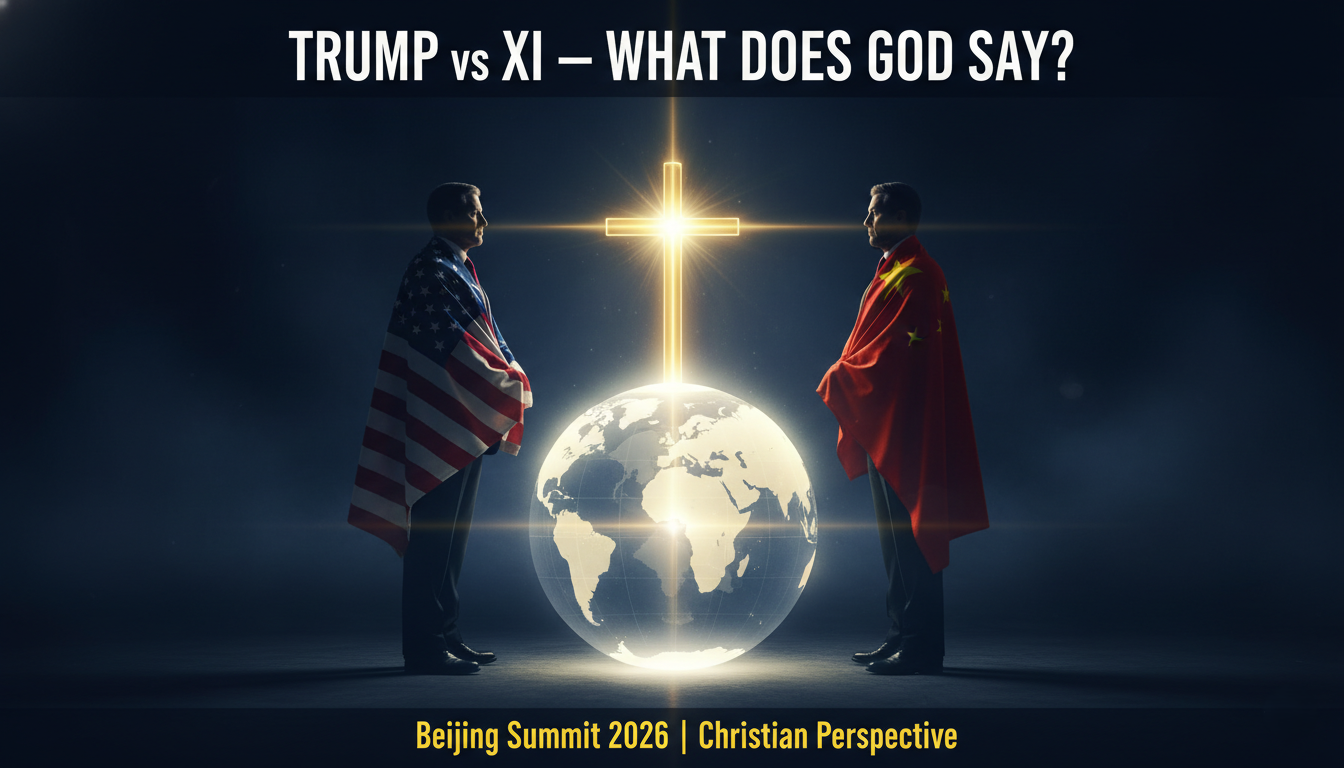
Two of the most powerful leaders on earth met in Beijing on May 14–15, 2026. U.S. President Donald Trump and Chinese President Xi Jinping sat across from each other in the former imperial gardens of Zhongnanhai, surrounded by ceremony, praise, and careful diplomacy. But beneath the polished surface of this historic summit, deep tensions remain.
From a Christian perspective, this meeting holds a mirror up to some timeless truths: the fragility of peace, the limits of human power, and the urgent need for wisdom in a world driven by competition and fear.
The two-day summit produced friendly optics but few concrete wins. Trump called the talks “fantastic” and said “a lot of different problems” were settled. Yet analysts widely noted that no major agreements were formally announced when Trump departed Beijing.
Some tangible outcomes did emerge in the days that followed. China agreed to purchase at least $17 billion in U.S. agricultural goods annually through 2028, and Beijing agreed to address American access to rare earth minerals, a key area of strategic vulnerability. Trump also announced that China would order 200 Boeing jets, and both leaders agreed to meet again in September in Washington, and later at the G20 Summit in Miami.
Yet experts described the meeting as more of a level-setting exercise than a genuine breakthrough. The concept of “constructive strategic stability” was put forward as a new framework for the relationship, at least over the next three years.
Perhaps no issue was more significant than Taiwan. Xi warned Trump directly that mishandling China’s claims over Taiwan could lead to “clashes and even conflicts” between the two countries. Trump, speaking afterward, called Taiwan the “most important” issue for Xi during the talks.
No substantial public commitment was made on Taiwan by either side. Trump said he had not yet decided whether to proceed with a $14 billion arms sale to the democratic island. Taiwanese officials reportedly expressed anxiety about being left off the agenda in a negative way, worried about being, as some put it, “on the menu” in a deal-making summit.
This is where Christian reflection becomes especially important.
The Bible consistently calls leaders toward peace. Romans 12:18 says, “If it is possible, as far as it depends on you, live at peace with everyone.” When powerful nations choose diplomacy over conflict, that is something to be grateful for, even when the motivations are mixed.
The fact that Trump and Xi met face-to-face, exchanged ideas, and agreed to meet again is genuinely better than the alternative. Christians can be thankful that dialogue remains open.
Both the U.S. and China came to Beijing wanting to appear strong. According to analysts, China aimed to consolidate its technological dominance and position in rare earth minerals, while the U.S. sought symbolic wins. Proverbs 16:18 warns: “Pride goes before destruction, a haughty spirit before a fall.”
When nations compete more for appearance and dominance than for justice and human flourishing, the risk of real conflict grows. This summit showed that pattern clearly.
While leaders discussed trade deals, Boeing jets, and soybeans, the deeper human issues, the suffering caused by the Iran war, the anxiety of ordinary Taiwanese citizens, and the economic pain of trade disputes, received far less attention.
Christianity teaches that powerful institutions have a responsibility to protect people, not just national interests. Matthew 25:40 reminds us that how we treat “the least of these” reflects our values at the deepest level.

One striking element of the summit was the public warmth between two leaders whose countries remain strategic rivals. Grand ceremonies, tours of historical gardens, lavish compliments, all of it was carefully staged.
Christians are wise to look past the performance. Scripture encourages discernment: “Do not put your trust in princes, in human beings, who cannot save” (Psalm 146:3). Diplomatic image-making is not the same as genuine peace or moral integrity.
The right questions to ask of any world leader are:
Christianity does not call believers to cynicism about government. In 1 Timothy 2:1–2, Paul urges that prayers be made “for kings and all those in authority, that we may live peaceful and quiet lives in all godliness and holiness.”
A balanced, biblical response to the Trump-Xi summit might look like this:
The world’s most important relationship, as both sides called it, is still fragile. And no trade deal or summit framework can replace the deeper work of wisdom, humility, and genuine peace.
The Trump-Xi Beijing Summit of 2026 is a reminder of how complex and imperfect our world is. Two powerful nations, driven by economics, military strategy, and political pride, are trying to avoid open conflict while protecting their own interests. That is the best human systems can often do.
But Christians are called to something higher. We pray not just for stability, but for wisdom. Not just for peace deals, but for justice. Not just for strong leaders, but for humble ones.
In a world where power dominates the headlines, the quiet, steady work of faith, prayer, discernment, compassion, and hope, still matters more than any summit.
Ready to explore more faith-based reflections on the world around us?
We’d love to hear your thoughts and questions. Whether you’re navigating current events through your faith or seeking deeper spiritual insight, our team is here to help.
👉 Contact Us Today — Let’s continue the conversation together.