Southern Baptists voted in Orlando to advance a formal ban on women pastors. Here is a clear, biblical look at what happened and what it means for the Church.

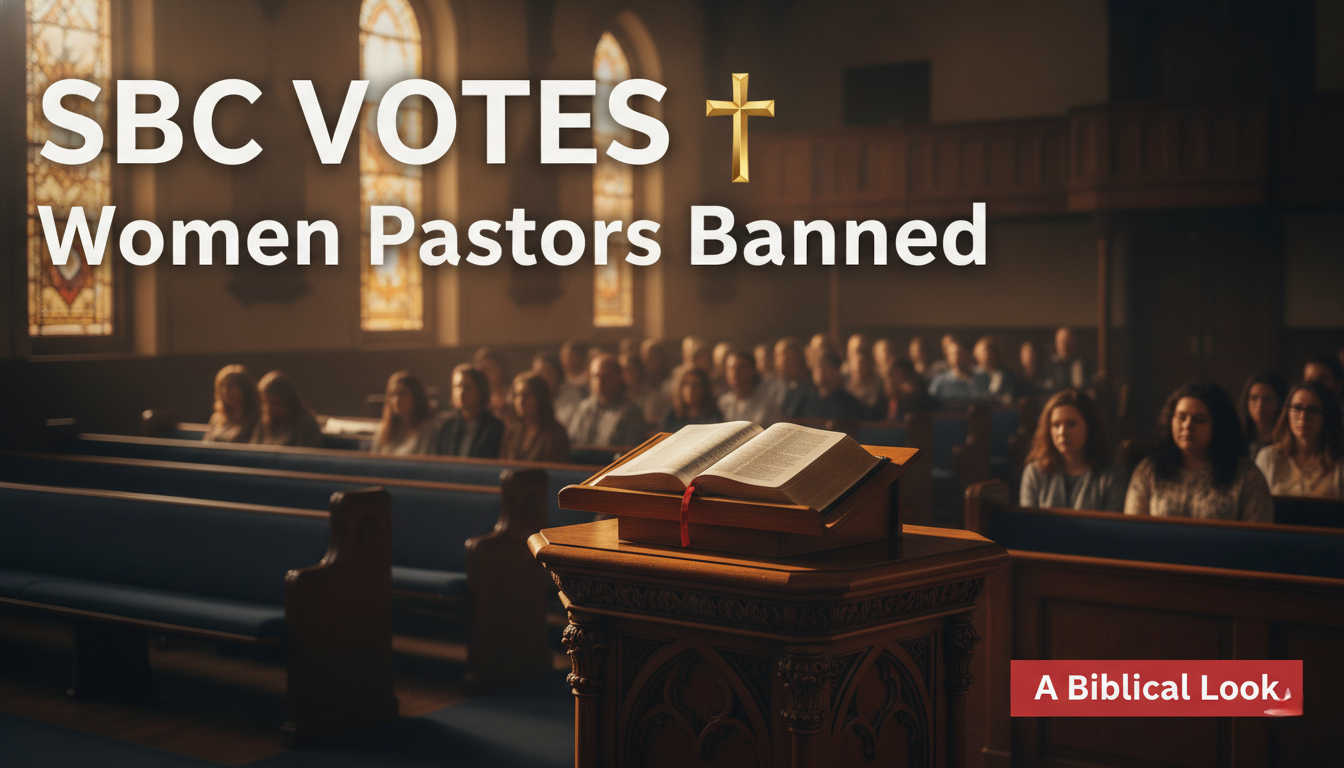
Something significant happened in Orlando this week. Thousands of Southern Baptists overwhelmingly voted Wednesday to advance a formal ban on women pastors in the nation’s largest Protestant denomination. For believers across America, this moment raises a deeper question: what does Scripture actually teach about church leadership, unity, and faithfulness to God’s Word?
Let’s walk through what happened and what it means from a biblical perspective.
The Southern Baptist Convention gathered in Orlando, Florida, for its annual meeting, drawing more than 11,000 messengers from cooperating churches nationwide. The headline event was a vote on what supporters called the “Truth and Unity Amendment.”
The vote at the annual meeting was 6,028 to 2,026, a 3-to-1 margin, which easily exceeded the required two-thirds majority. The measure was sponsored by Albert Mohler, president of The Southern Baptist Theological Seminary.
This vote is not yet final. A second vote will be held at next year’s SBC Annual Meeting in Indianapolis, Indiana, to give final approval to the amendment. The convention’s process requires two consecutive years of approval before a constitutional change takes effect.
The SBC already affirmed in its statement of faith that the pastoral office is reserved for qualified men. So why the amendment? Supporters argued the denomination needed clearer constitutional language. Beyond banning women from holding the office of pastor, the amendment now prohibits women from performing the functions of a pastor, specifically “preaching to the assembled congregation.”
For Southern Baptists, this is not primarily a cultural or political question. It flows from how they read Scripture.
The denomination holds a complementarian view, the belief that men and women are equal in worth and dignity before God, yet called to distinct roles in the home and church. This conviction draws from passages such as 1 Timothy 2:12 and Titus 1:6, where Paul addresses qualifications for the office of overseer and elder.
Supporters point to 1 Timothy 3:1-2, where Paul describes the overseer as “the husband of one wife,” and to the broader pattern of male eldership found throughout the New Testament. For them, faithfulness to these texts is an act of obedience, not exclusion.

Scripture also celebrates the vital ministry of women. Phoebe served as a deacon (Romans 16:1). Priscilla taught alongside her husband (Acts 18:26). Lydia opened her home to the early church (Acts 16:14-15). The complementarian position does not silence women but understands their callings within a particular biblical framework. Faithful churches continue to honor women in teaching, missions, mercy ministry, and discipleship.
This debate has not been without tension. The vote has boosted concerns among advocates who say it could limit women’s voices in the church. Critics worry the language could be read broadly. Others raised concerns about local church autonomy, a long-cherished Baptist principle.
Here Scripture offers wise counsel. The Apostle Paul urged believers in Ephesians 4:3 to be “eager to maintain the unity of the Spirit in the bond of peace,” even while contending for truth. Doctrinal conviction and Christian love are not enemies. The challenge for any church is holding both.
Whatever your view, this moment is a reminder that the Church is called to faithfully steward God’s Word for future generations. Debates over governance, leadership, and doctrine are not new. The early church wrestled with hard questions too, always returning to Scripture and the Lordship of Christ.
The world is watching how Christians treat one another. Our commitment to truth must always be matched by our commitment to love, as 1 Corinthians 16:14 reminds us: “Let all that you do be done in love.”
As Southern Baptists look toward the final vote in Indianapolis, believers everywhere are invited to pray for wisdom, humility, and a renewed focus on the Great Commission, the mission that unites the Church above every disagreement.
Walking through faith and culture together. At Faith Focus Journal, we explore today’s biggest questions through the lens of Scripture. Have thoughts on this story or a topic you’d like us to cover? Reach out to us through our contact page, we would love to hear from you.