The Japanese art of gyotaku captures an impression that cannot be faked. This reflection explores what it teaches us about being made in the image of God and living an authentic, transformed Christian life.

A Reflection on Authenticity, Transformation, and the Christian Life
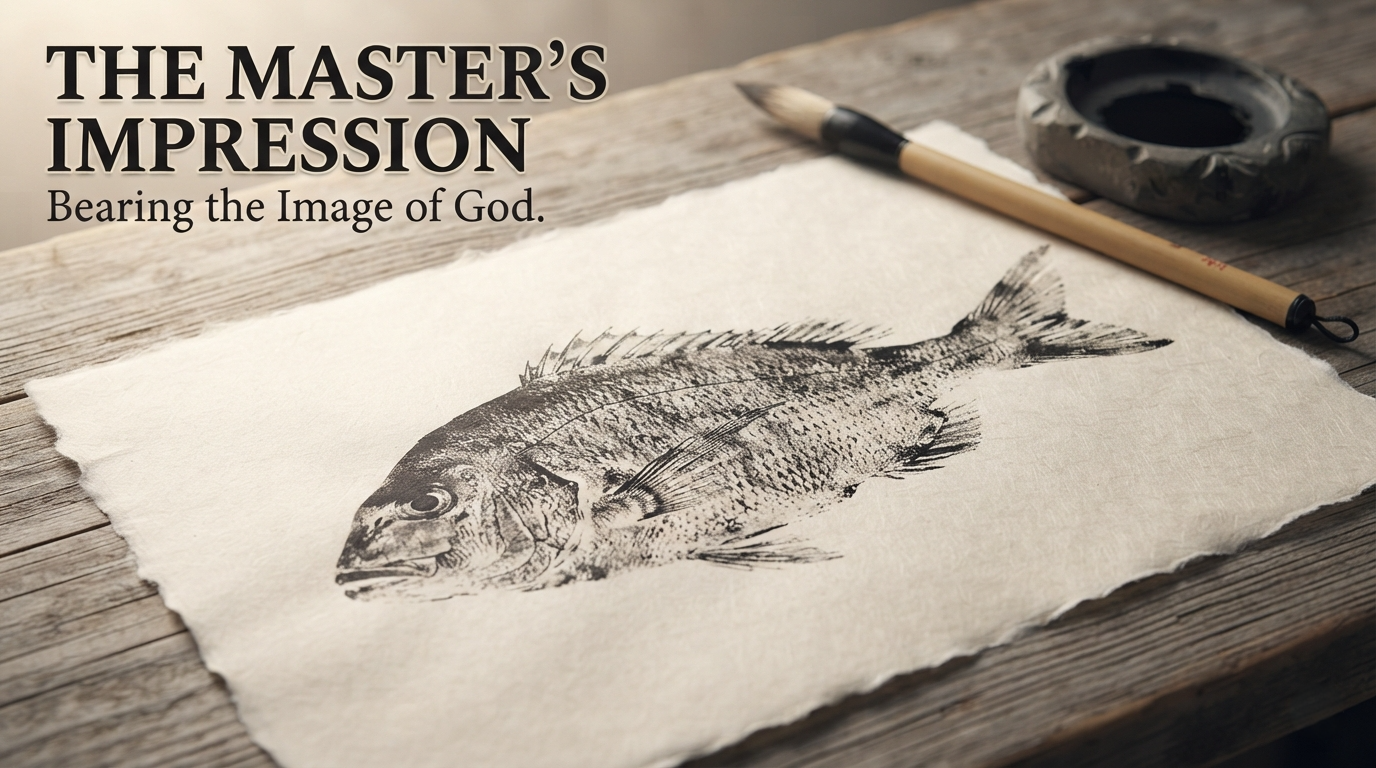
There is something fascinating about the Japanese art of gyotaku. Long before fiberglass replicas and artificial displays became common, fishermen in Japan found a way to preserve the memory of their catch by covering the fish with non-toxic sumi ink and gently pressing it onto rice paper. The result was an authentic impression, one that could not exaggerate the size, alter the shape, or hide imperfections. The fish left behind exactly what it was. Then, remarkably, the fish could still be cleaned, prepared, and eaten.
That simple process carries a powerful spiritual lesson.
Scripture teaches that every human being was created in the image of God.
“So God created mankind in His own image, in the image of God He created them; male and female He created them.” — Genesis 1:27
Just as the fish leaves its impression upon the paper, every life leaves an impression upon the world. The question is not whether we are leaving one. The question is, whose image are we reflecting?
Our culture often encourages us to become replicas, carefully constructed versions of ourselves designed to impress others. We polish our appearance, exaggerate our accomplishments, hide our failures, and hope no one notices the cracks. Like modern replica taxidermy, we can become more concerned with perception than authenticity.
But God has never asked His people to become replicas. He calls us to become reflections.
The Apostle Paul writes,
“And we all… are being transformed into His image with ever-increasing glory.” — 2 Corinthians 3:18
Notice the difference. God is not interested in creating copies that merely look religious. He desires hearts transformed by His Spirit. Christianity is not cosmetic; it is transformational.
Gyotaku reminds us that an authentic impression cannot be faked. Every scale, every contour, every mark is transferred honestly onto the paper. Likewise, our lives reveal what truly fills our hearts.
Jesus said, “For out of the abundance of the heart the mouth speaks.” — Matthew 12:34
Eventually, what is inside always becomes visible.
That truth can be uncomfortable, but it is also hopeful. Christ never intended for us to spend our lives pretending. He invites us to come honestly before Him. King David prayed,
“Search me, O God, and know my heart; test me and know my anxious thoughts.” — Psalm 139:23–24
God already knows every flaw, every wound, and every hidden struggle. Yet He still chooses to love us. The gospel is not about presenting a flawless impression; it is about surrendering our imperfect lives to a perfect Savior.

Another remarkable aspect of gyotaku is that the fish continues to serve its purpose even after leaving its impression. The print preserves the memory, while the fish nourishes others. Christ calls believers to live in much the same way.
“You are the light of the world… let your light shine before others, that they may see your good works and glorify your Father in heaven.” — Matthew 5:14–16
Our lives should leave an imprint that points people toward Jesus while simultaneously feeding others spiritually through kindness, encouragement, generosity, forgiveness, and truth. Paul describes believers as “the aroma of Christ” (2 Corinthians 2:15), meaning our presence should remind people of Him long after we have gone.
Marine biologists have even used gyotaku to preserve the details of fish species for future generations. What began as a fisherman’s record became a historical witness. Christians are called to become living testimonies.
“You yourselves are our letter… written not with ink but with the Spirit of the living God.” — 2 Corinthians 3:2–3
The greatest testimony is not written on paper but upon transformed lives. One day, every conversation, every decision, every act of mercy, and every moment of obedience will have left an impression somewhere. Children will remember it. Friends will remember it. Communities will remember it. More importantly, eternity will reveal it.
Jesus reminded His followers, “By this everyone will know that you are My disciples, if you love one another.” — John 13:35
Love is the clearest imprint of Christ.
As followers of Jesus, we should ask ourselves:
Gyotaku teaches that authentic impressions cannot be manufactured. In the same way, a genuine Christian life cannot be produced through appearances, traditions, or performance. It is formed only through daily surrender to Christ.
May we become people whose lives bear the unmistakable imprint of our Creator. Because in the end, the greatest masterpiece is not the one hanging on a wall. It is a life transformed by Jesus Christ.
“And just as we have borne the image of the earthly man, so shall we bear the image of the heavenly Man.” — 1 Corinthians 15:49
Walking through faith and culture together. At Faith Focus Journal, we explore Scripture and everyday life through reflections that draw us closer to Christ. Did this reflection speak to you, or is there a topic you’d like us to explore? Reach out through our contact page. We would love to hear from you.