The Ohio governor race remains highly competitive as Vivek Ramaswamy and Amy Acton prepare for Election Day. For Christians, the contest is also a reminder to seek wisdom, pray for leaders and place ultimate hope in God.
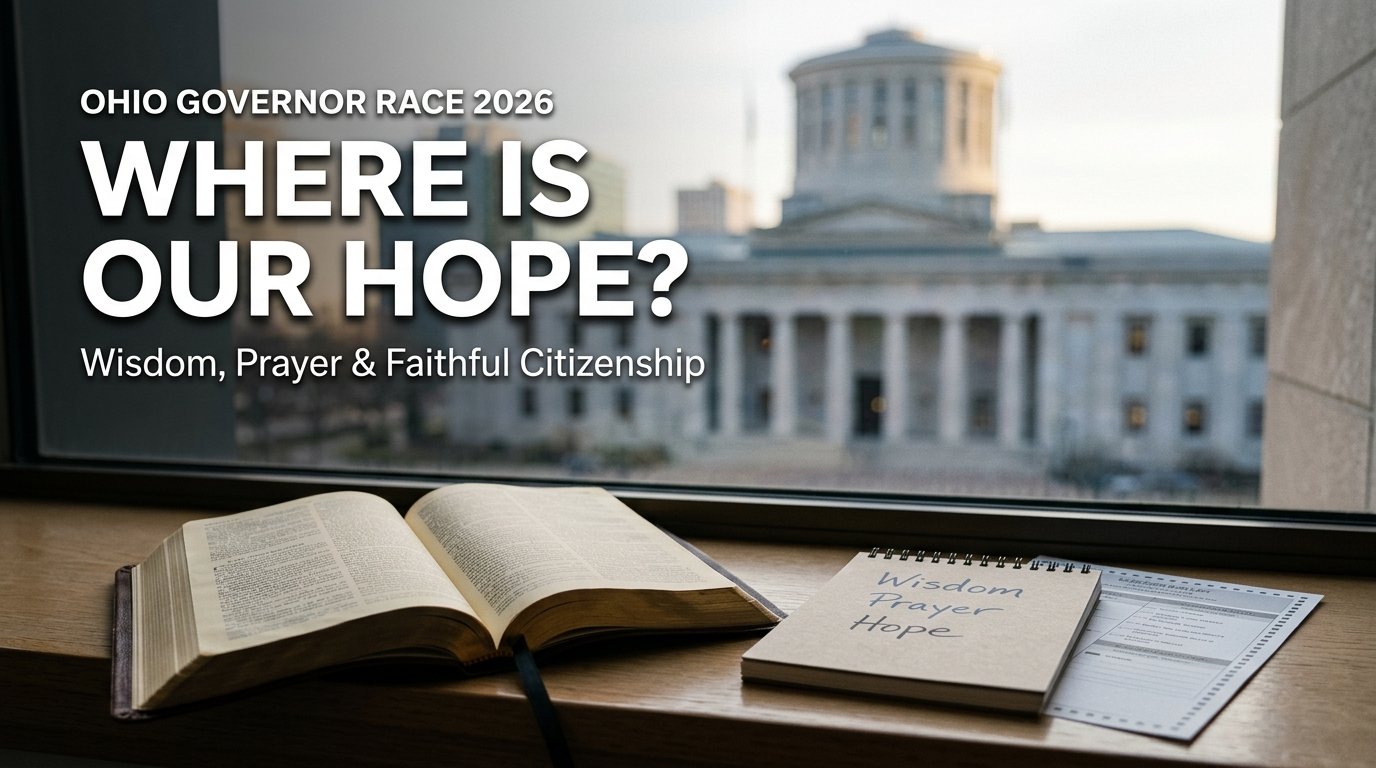
COLUMBUS, Ohio – Ohio voters are heading toward a closely watched gubernatorial election as Republican nominee Vivek Ramaswamy faces Democratic nominee Dr. Amy Acton in a race that remains highly competitive.
Ohio Gov. Mike DeWine, a Republican, is unable to seek another consecutive term because of the state’s term limits. Ramaswamy won the Republican nomination in May, while Acton secured the Democratic nomination without a primary challenger. The general election is scheduled for November 3, 2026.
Recent polling shows just how close the contest has become. RealClearPolitics currently lists Acton at 47.3% and Ramaswamy at 47.0%, an average difference of only 0.3 percentage points, and classifies the race as a toss-up. Other recent polling has produced different results, including an August Fox News poll showing Ramaswamy ahead 50% to 48%.
That uncertainty is a reminder that polls measure public opinion at a particular moment. They do not determine elections. Campaign events, debates, policy discussions, voter turnout and changing public opinion can all influence the final result.
Ramaswamy, a Cincinnati native, is a businessman and former presidential candidate who is now seeking the governorship of his home state. His campaign has emphasized economic growth, lower costs, education and limiting government regulation.
Acton is a physician who previously served as director of the Ohio Department of Health. She was appointed by Gov. DeWine in 2019 and became widely known during the COVID-19 pandemic while serving as the state’s top public health official.
The candidates offer voters different visions for Ohio’s future, and their campaigns are expected to focus on issues including the economy, education, government spending, public health and the role of state government.
Christians following the campaign should be willing to understand those differences carefully rather than relying only on slogans, social media posts or partisan commentary.
Political participation is not contrary to Christian faith. Scripture calls believers to pursue wisdom, truth, justice and the good of their communities. But Scripture also warns against treating political power as the ultimate source of security.
James 1:5 offers a straightforward instruction for moments when difficult decisions require discernment:
“If any of you lack wisdom, let him ask of God.”
That principle applies to political decisions as well.
Christians may study the candidates’ positions, examine their records, consider their character and think carefully about how proposed policies could affect families, communities and vulnerable people.
But Christian discernment requires more than finding a candidate who agrees with us.
It means asking better questions.
Does a proposed policy promote justice? Does it respect human dignity? Does it protect the vulnerable? Does it encourage responsibility? Does it recognize the limits of government? Does the candidate speak truthfully, even when doing so is politically difficult?
These questions do not always produce identical answers among faithful Christians. Believers can study the same issues and reach different conclusions while still treating one another with humility and love.
Psalm 146:3 gives Christians an important warning:
“Put not your trust in princes, nor in the son of man, in whom there is no help.”
The passage does not tell believers to abandon civic responsibility. Instead, it places political authority in its proper perspective.
Governors matter. Laws matter. Public policies matter. Decisions made by elected officials can affect schools, businesses, families, health care, public safety and countless other parts of daily life.
Yet no governor can become the source of ultimate hope.
No election can fix the human heart.
No political party can establish the kingdom of God.
And no candidate can carry the weight of expectations that belong only to the Lord.
That distinction is especially important during a close election. When political contests become emotionally intense, Christians can easily begin treating political victory as if it were spiritual victory.
It is not.
A candidate may win an election and still govern imperfectly. Another candidate may lose an election and still have a meaningful opportunity to serve neighbors and communities.
Our responsibility is faithfulness, not control.
The closeness of the Ohio race also provides an opportunity for Christians to practice something Scripture commands regardless of political preference: prayer.
Paul wrote in 1 Timothy 2:1-2 that believers should offer “supplications, prayers, intercessions, and giving of thanks” for those in authority.
That instruction is striking because Christian prayer for leaders is not dependent on political agreement.
Christians should pray for Ramaswamy.
Christians should pray for Acton.
Christians should pray for Gov. DeWine as he completes his time in office.
And Christians should pray for legislators, judges, local officials and others who carry responsibility for the people they serve.
Prayer does not mean asking God to guarantee our preferred political outcome. It means recognizing that God remains sovereign regardless of the outcome.
The 2026 election season is already taking place in a highly charged political environment.
That makes Christian conduct especially important.
In early September, Acton was unharmed after an armed individual forced through a crowd during her appearance at the Canfield Fair. The suspect was arrested, and Ramaswamy’s campaign joined other political voices in condemning the incident. The event was another reminder that political disagreement must never become an excuse for violence.
Christians should be able to disagree strongly without dehumanizing people.
Ephesians 4:15 calls believers to speak “the truth in love.” That combination matters.
Truth without love can become harshness.
Love without truth can become compromise.
Christian citizenship requires both.
Voters do not have to pretend that every candidate is equally qualified or that every policy is equally wise. They can debate serious issues and reach strong conclusions. But they should remember that every person involved in the political process is made in the image of God.
The Ohio governor’s race may remain close all the way to Election Day.
Polling averages can shift. New surveys can produce different results. Campaign events can change the political environment. And ultimately, voters rather than pollsters will determine who becomes Ohio’s next governor.
But Christians have a reason for hope that does not depend on a polling average.
Psalm 20:7 declares:
“Some trust in chariots, and some in horses: but we will remember the name of the Lord our God.”
The political language of the passage is ancient, but the spiritual principle remains relevant.
People have always been tempted to place their confidence in visible sources of power. In one generation it may be military strength. In another it may be wealth, political influence, institutions or elections.
Christians are called to remember where their confidence truly belongs.
The next governor of Ohio will have important responsibilities. That person will make decisions that affect millions of people. Christians should take the election seriously, learn about the candidates, vote responsibly and pray faithfully.
But they should also remember that Ohio’s future is ultimately not held by a campaign.
It is held by God.
Christians do not need to withdraw from public life to remain faithful to Scripture.
They can vote.
They can participate in civic discussions.
They can support policies they believe are just.
They can respectfully challenge policies they believe are harmful.
They can encourage good leadership and hold public officials accountable.
And they can pray for leaders with whom they strongly disagree.
What Christians cannot afford to do is place their ultimate hope in political power.
Ramaswamy may win.
Acton may win.
The polls may be right.
The polls may be wrong.
But neither outcome changes the character of God.
As Ohio voters consider the future of their state, Christians can pursue wisdom without fear, truth without hostility and civic responsibility without making politics an idol.
The election matters.
But God matters more.
The major-party nominees are Republican Vivek Ramaswamy and Democrat Amy Acton. Libertarian candidate Don Kissick is also listed among the general-election candidates.
The general election is scheduled for November 3, 2026.
Current polling shows a very competitive contest. RealClearPolitics lists Acton at 47.3% and Ramaswamy at 47.0%, while other recent polls have shown either candidate with a small advantage.
Scripture encourages Christians to pray for those in authority, pursue wisdom and remember that human leaders are limited. See 1 Timothy 2:1-2, James 1:5 and Psalm 146:3.
Christians are called to place their ultimate hope in God rather than political candidates, parties or election outcomes. Psalm 20:7 reminds believers to remember the name of the Lord rather than trusting in earthly sources of power.
At Faith Focus Journal, we explore politics and public life through the lens of Scripture. As Ohio voters consider their choices, may Christians pursue wisdom, practice humility, pray for leaders and remember that their ultimate hope is found in God, not in an election result. Reach out through our contact page. We would love to hear from you.