ORANGEBURG, S.C. – Former Transportation Secretary Pete Buttigieg returned to South Carolina on August 22 as speculation continues about whether he might seek the Democratic presidential nomination in 2028.
Buttigieg’s visit included appearances at the South Carolina Democratic Party’s Spratt Issues Conference in Florence, a visit to Claflin University in Orangeburg and an NAACP Freedom Fund Dinner at Edisto Fork United Methodist Church. The trip brought him back to a state where his 2020 presidential campaign struggled to connect with Black voters, but where his reception this time was considerably warmer.
Buttigieg has not announced a 2028 presidential campaign. During the South Carolina visit, he told reporters, “Right now, I’m totally focused on 2026.” Still, his decision to spend time in an early presidential primary state has naturally fueled speculation about his political future.
For Christians, the attention surrounding a possible presidential campaign offers an opportunity to consider an important biblical question: How should believers engage politics without allowing politics to become the source of their identity, hope or division?
Scripture calls Christians to seek wisdom, listen carefully, reject partiality, pursue justice and pray for those in authority.
It also reminds believers that political power, no matter how significant it may appear, is temporary.
Buttigieg Returns to a State That Shaped His 2020 Campaign
South Carolina holds an especially important place in Buttigieg’s political history.
During the 2020 Democratic presidential primary, he finished fourth in the state’s contest. The result contributed to his decision to end his campaign shortly afterward.
This time, his reception was notably different.
At the NAACP Freedom Fund Dinner in Orangeburg, more than 200 people attended, and Buttigieg received a standing ovation. He also received a warm response when local leaders highlighted his role in helping secure federal transportation funding for Orangeburg during his time as transportation secretary.
Buttigieg also met with students at Claflin University, a historically Black university in Orangeburg.
The visit gave him an opportunity to speak directly with voters and community members in a state where Black Democrats are expected to have substantial influence in the 2028 Democratic nomination process.
South Carolina is expected to be the first state in the Democratic presidential primary calendar in 2028, giving its voters an important early role in shaping the field.
But a warm reception at one event is not the same as securing lasting political support.
The 2028 presidential field remains unsettled, and no candidate can know today what voters will ultimately prioritize.
A Record of Federal Investment in Orangeburg
During his visit, Buttigieg also pointed to his record as transportation secretary.
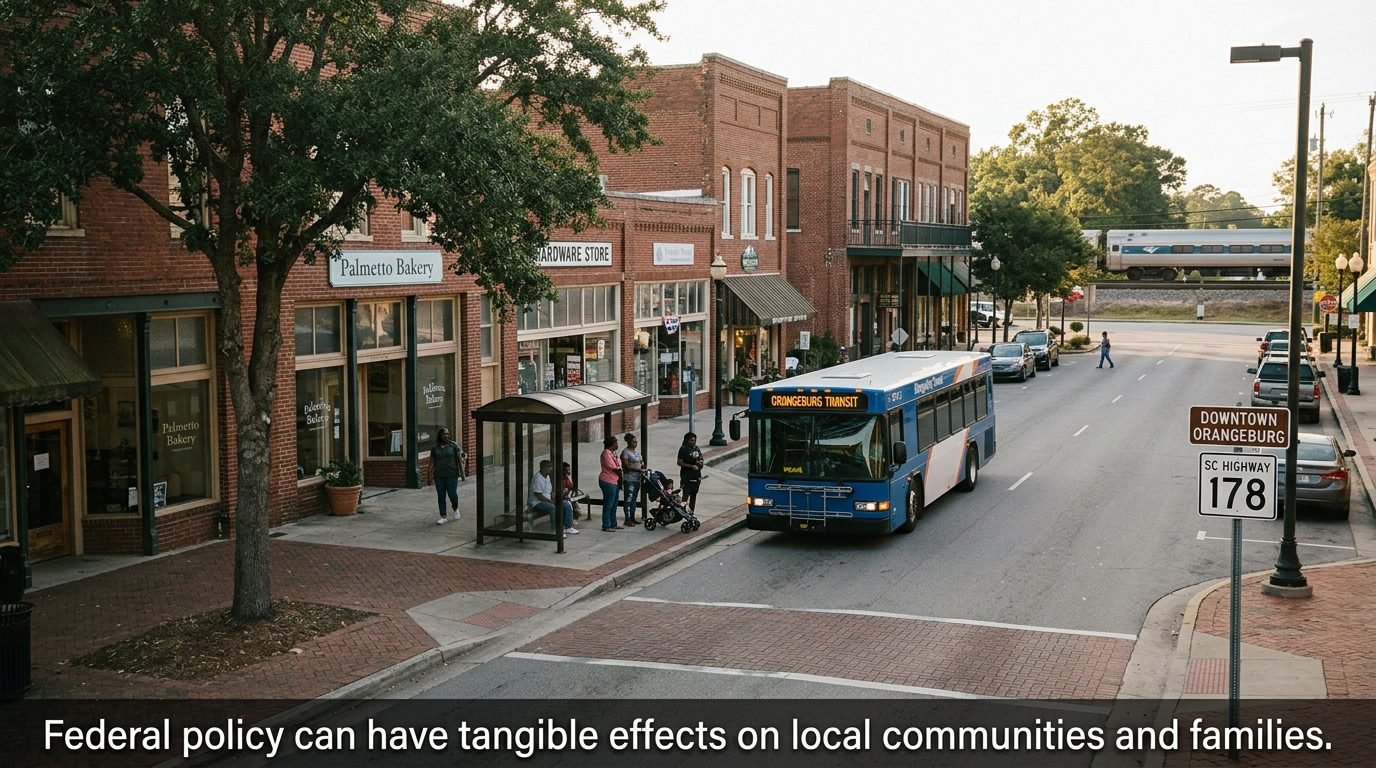
In 2023, the U.S. Department of Transportation announced a $22.7 million RAISE grant for Orangeburg. The funding was intended to support a pedestrian bridge and multimodal transit hub connecting neighborhoods, college campuses and downtown Orangeburg.
The project became part of Buttigieg’s message during his return to the community.
Local officials credited him with helping bring federal resources to the area, demonstrating how political decisions made in Washington can have tangible effects in local communities.
That reality is worth remembering from a Christian perspective.
Government decisions are not merely abstract arguments on television. Roads, schools, infrastructure, public safety, economic policies and other government choices can affect real families and communities.
Christians therefore should not become so detached from public life that they stop caring about the people affected by political decisions.
At the same time, caring about government does not mean trusting government to provide what only God can provide.
Christians Are Called to Listen Before Speaking
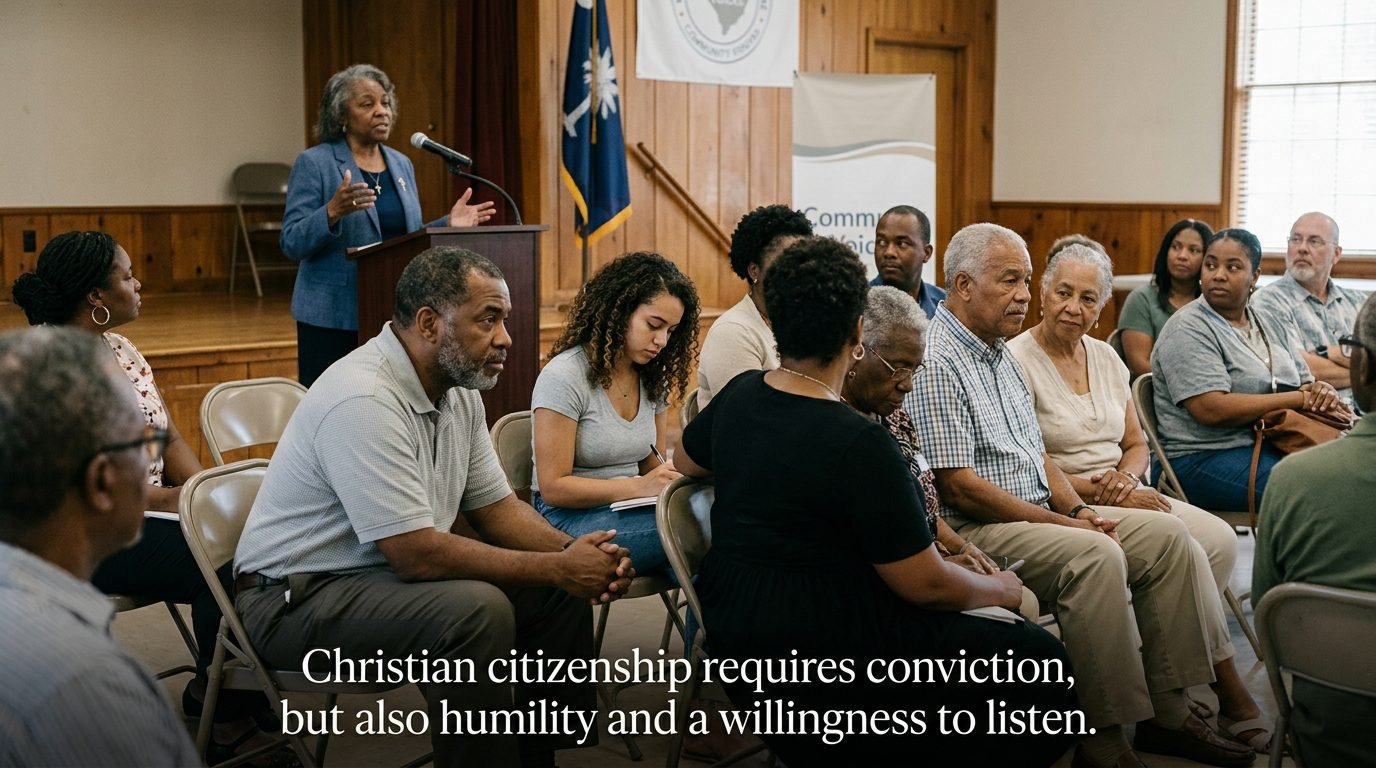
One of the most valuable principles Christians can bring into political conversations is the discipline of listening.
James 1:19 says:
“Let every man be swift to hear, slow to speak, slow to wrath.”
That instruction is particularly relevant in an era when political conversations can quickly become hostile.
Listening does not mean agreeing with everything someone says.
It does not mean abandoning biblical convictions.
And it does not mean refusing to identify policies or ideas that Christians believe are wrong.
Instead, listening means taking the time to understand people before responding to them.
Buttigieg’s South Carolina visit illustrates the importance political candidates place on listening to communities they hope to represent. His outreach to Black voters, students and local leaders reflects the reality that political leadership requires engagement with people whose experiences may differ from one’s own.
Christians should practice that same willingness to listen.
Before responding to a political argument, believers can ask:
What is this person actually saying?
What experiences have shaped their concerns?
What part of their argument should I consider?
Does Scripture affirm or challenge what I am hearing?
Am I responding with truth and love, or simply reacting because I dislike the person or political party involved?
These questions can help Christians remain thoughtful when political disagreement becomes intense.
Rejecting Partiality in Political Life
James 2:1 warns believers against showing partiality while claiming faith in Jesus Christ.
The passage addresses distinctions based on social status, but the principle has broader implications for Christian conduct.
Christians should be careful about allowing political identity to determine how they treat people.
It is easy to speak respectfully about someone who supports our preferred candidate while dismissing someone who supports another party.
But the Christian calling is higher than partisan loyalty.
Every person has dignity because every person bears God’s image.
That includes political opponents.
It includes people who vote differently.
It includes candidates whose policies Christians strongly oppose.
And it includes people with whom believers may disagree on deeply important cultural and political questions.
This does not require political neutrality.
Christians can hold convictions.
They can vote according to conscience.
They can advocate for justice.
They can oppose policies they believe violate biblical principles.
But they should do so without hatred or contempt.
Wisdom Matters More Than Political Loyalty
James 1:5 provides another essential principle:
“If any of you lack wisdom, let him ask of God, that giveth to all men liberally.”
Political decisions often involve competing priorities.
Voters may care about economic opportunity, education, health care, transportation, public safety, religious liberty, poverty, national security or the environment.
Christians will not always agree about how those concerns should be balanced.
That is precisely why believers need wisdom.
Instead of beginning with the question, “What does my party want me to believe?” Christians can begin with a better question:
“What is wise and faithful before God?”
That question does not produce a simple answer every time.
But it changes the posture with which believers approach politics.
Rather than treating political leaders as heroes or enemies, Christians can evaluate them carefully.
Rather than accepting every campaign claim, believers can examine evidence.
Rather than allowing social media to shape every opinion, Christians can slow down and seek understanding.
And rather than assuming that one election will solve everything, believers can remember that no earthly government can establish God’s kingdom.
Political Leadership Is Important, But It Is Not Ultimate
Proverbs 29:2 says:
“When the righteous are in authority, the people rejoice: but when the wicked beareth rule, the people mourn.”
Scripture does not treat leadership as unimportant.
Good leadership can benefit communities.
Corrupt leadership can cause suffering.
Justice and righteousness matter in public life.
That means Christians should care about who holds political office and how those leaders exercise authority.
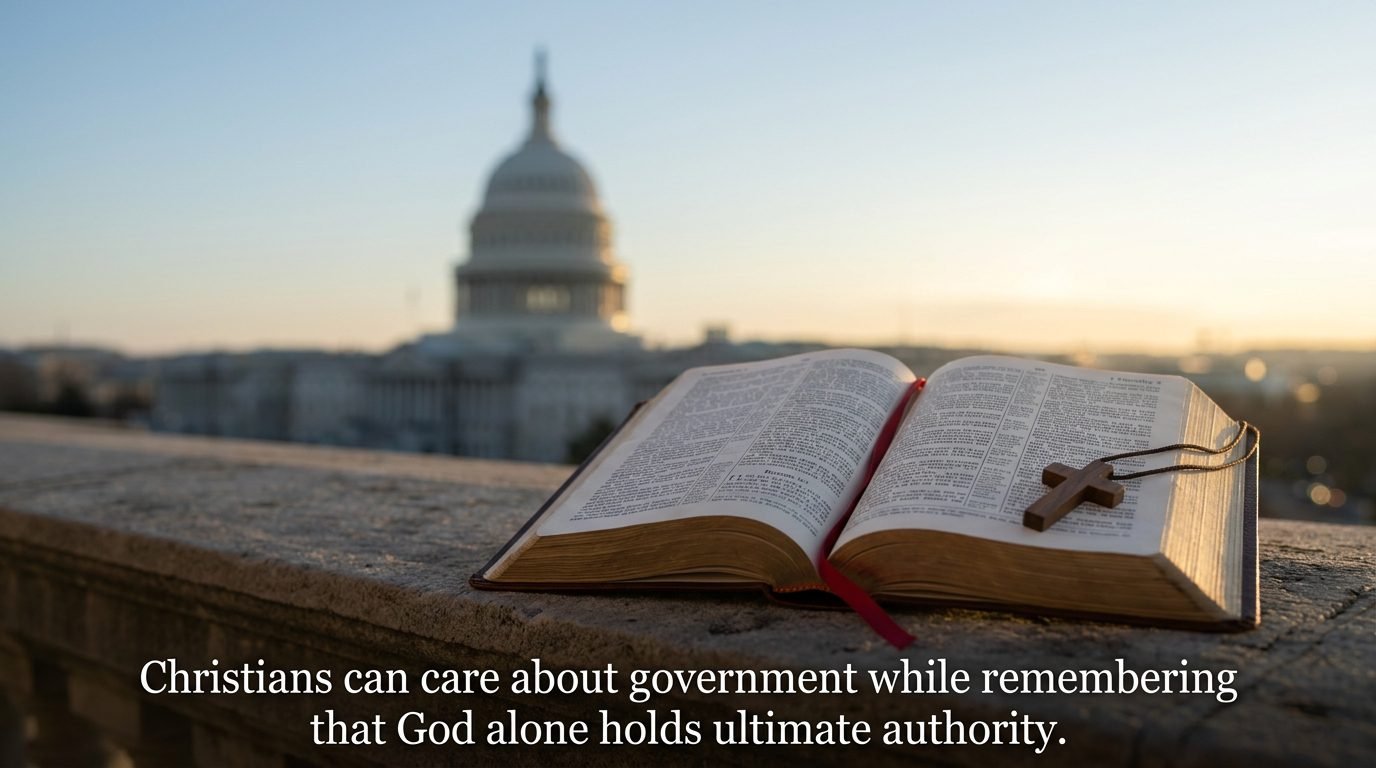
But Scripture also places human government under the larger authority of God.
Political leaders are not sovereign.
Presidents are not sovereign.
Political parties are not sovereign.
Voters are not sovereign.
God is.
That distinction protects Christians from both political apathy and political idolatry.
Believers can take elections seriously without treating them as ultimate.
Christians Are Called to Pray for Those in Authority
The Christian response to political uncertainty should include prayer.
Paul writes in 1 Timothy 2:1-2:
“I exhort therefore, that, first of all, supplications, prayers, intercessions, and giving of thanks, be made for all men; for kings, and for all that are in authority.”
Notice that the instruction is not limited to leaders Christians personally admire.
Believers are called to pray for those in authority.
That means Christians can pray for President Donald Trump, Congress, governors, judges and local officials.
They can also pray for candidates considering future campaigns.
And they can pray for political opponents.
Prayer changes the posture of the believer.
Instead of assuming that everything depends on our political influence, we acknowledge our dependence on God.
Instead of responding to uncertainty with fear, we bring our concerns before the Lord.
Instead of allowing political anger to consume us, we remember that God remains at work even when political circumstances are difficult.
Hope Beyond Washington
Buttigieg’s South Carolina visit may eventually become part of the story of the 2028 presidential campaign.
It may prove to be an early step toward another presidential bid.
Or it may simply become one chapter in the political life of a former cabinet secretary who has not yet decided what comes next.
At this point, the future remains uncertain.
But Christians do not have to fear uncertainty.
Psalm 146:3 warns:
“Put not your trust in princes, nor in the son of man, in whom there is no help.”
That verse does not call believers to abandon civic responsibility.
It calls them to put political leadership in its proper place.
A candidate may promise change.
A president may sign legislation.
A political party may win an election.
But none of those things can provide the eternal security found in Christ.
Psalm 22:28 declares:
“For the kingdom is the Lord’s: and he is the governor among the nations.”
Earthly governments rise and fall.
Political movements gain influence and lose it.
Candidates become presidents and eventually leave office.
But Christ’s kingdom is not dependent on an election.
Faithful Citizenship Without Political Idolatry
The 2028 presidential conversation is already beginning, even though the election remains years away.
Potential candidates are visiting early states.
Political organizations are organizing.
Voters are considering possible leaders.
And communities are listening to people who may eventually ask for their votes.
Christians can participate in all of this responsibly.
They can listen.
They can study.
They can vote.
They can serve.
They can advocate for justice.
They can challenge wrongdoing.
They can pray for leaders.
And they can disagree without hatred.
But through all of it, believers are called to remember where their deepest hope is found.
Not in Washington.
Not in a political party.
Not in a presidential candidate.
Not in an election victory.
Our hope is in Christ.
Political authority is temporary, but Christ’s reign is eternal. Elections can determine who exercises earthly authority, but they cannot determine the ultimate purposes of God.
As candidates consider whether they will seek the presidency in 2028, Christians can do something more important than predict the political future.
They can seek God’s wisdom today.
Frequently Asked Questions
Is Pete Buttigieg running for president in 2028?
No. Buttigieg has not announced a 2028 presidential campaign. During his August 2026 South Carolina visit, he said he was currently focused on the 2026 elections.
Why is South Carolina important for the 2028 presidential race?
South Carolina is expected to be the first state in the Democratic presidential primary calendar for 2028. Its large Black Democratic electorate gives voters there significant influence in the early nomination process.
Why did Buttigieg return to South Carolina?
His August 2026 visit included the Spratt Issues Conference, Claflin University and an NAACP Freedom Fund Dinner. The trip allowed him to reconnect with South Carolina voters, particularly Black voters, after struggling with that constituency during his 2020 campaign.
What federal project is associated with Buttigieg in Orangeburg?
The U.S. Department of Transportation awarded Orangeburg $22.7 million through the RAISE program in 2023 for a pedestrian bridge and multimodal transit hub designed to connect neighborhoods, college campuses and downtown.
What does the Bible say about Christians and political leaders?
Scripture calls Christians to seek wisdom, reject partiality, pray for those in authority and remember that earthly rulers are not the ultimate source of hope. James 1:5, James 2:1, 1 Timothy 2:1-2 and Psalm 146:3 all speak to these principles.
Walking Through Faith and Culture Together
At Faith Focus Journal, we explore politics and public life through the lens of Scripture. As the 2028 political landscape begins to take shape, Christians can listen carefully, pursue wisdom, treat every person with dignity and pray for leaders while remembering that their ultimate hope rests in Christ. Reach out through our contact page. We would love to hear from you.