A decade after being fired by American Airlines, Scott Kirby now leads a more profitable United. Here is a biblical perspective on competing with integrity rather than revenge.

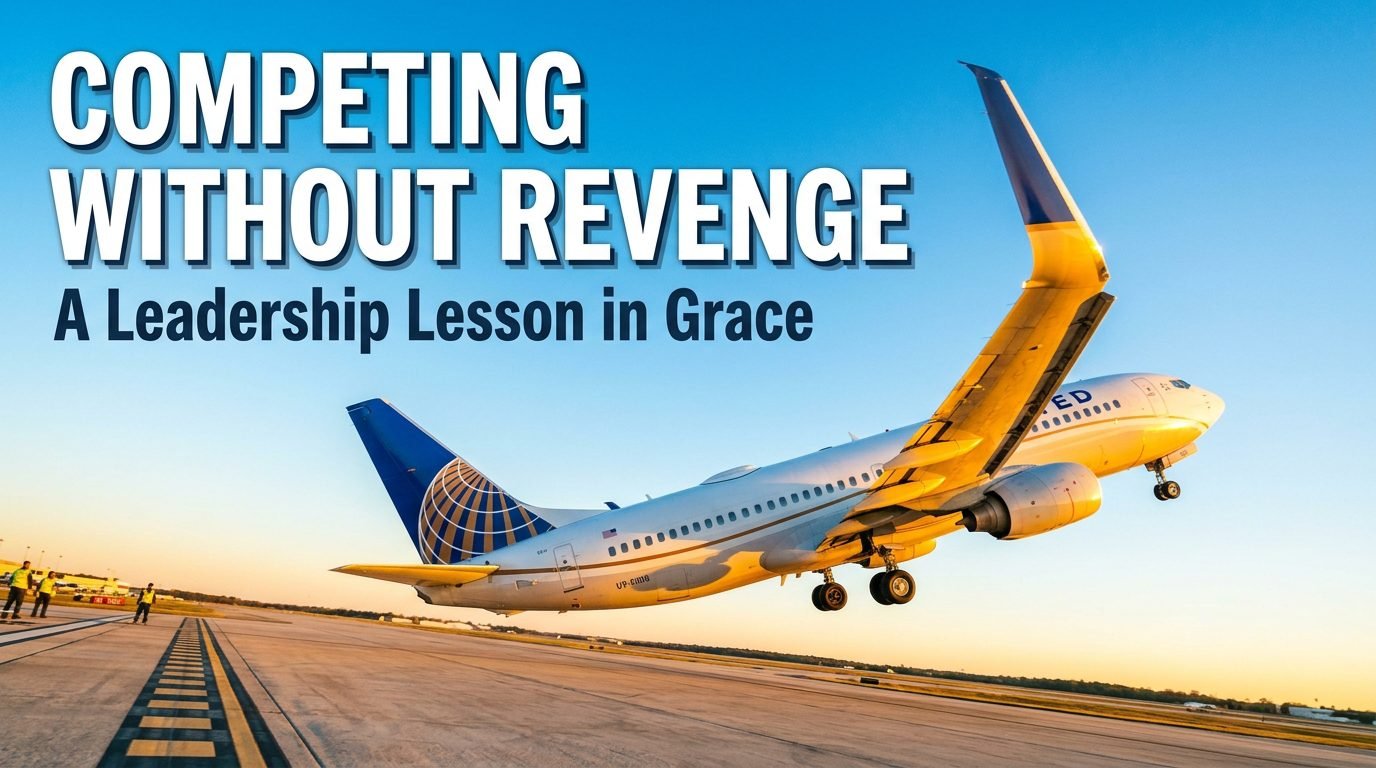
By Faith Focus Journal News Desk
NEWARK, N.J. — United Airlines CEO Scott Kirby says he does not believe in revenge.
A decade after American Airlines fired him from his position as president, Kirby has become one of the most prominent executives in the U.S. airline industry. Today, he is leading United through an ambitious period of expansion while pursuing new international routes, technological innovation and potential opportunities for growth.
“Everyone thinks I do, but no, I don’t,” Kirby told CNBC when discussing his former employer. “I compete aggressively.”
Kirby’s comments offer a glimpse into the mindset of an executive who has turned a major career setback into an opportunity to lead one of the country’s largest airlines. His story also raises broader questions about how leaders respond to rejection, competition and professional adversity.
Kirby’s departure from American Airlines in August 2016 was followed almost immediately by the announcement that he would become president of United Airlines.
“I joke that most people take a few weeks, a couple months between jobs. I took 60 seconds,” Kirby said.
United eventually promoted Kirby to CEO in May 2020, just as the airline industry was confronting the unprecedented challenges created by the COVID-19 pandemic. Since then, Kirby has overseen an extensive effort to strengthen United’s network, improve its products and expand its international presence.
The airline is now the second-most profitable major U.S. carrier behind Delta Air Lines, while American Airlines has remained behind both competitors in profitability. In the first half of 2026, United carried 18.9 million international passengers, according to Bureau of Transportation Statistics data, compared to American’s 17.4 million.
Kirby is not content with maintaining United’s current position. He has explored ways to expand United’s presence at New York’s John F. Kennedy International Airport, with the airline planning to return to JFK through a partnership with JetBlue as early as 2027, and has discussed potential opportunities to acquire additional airport slots from carriers that may not be operating profitable routes.

United already maintains the largest international network among major U.S. airlines, but Kirby wants to expand that footprint even further. The company is preparing to announce additional international routes, continuing a strategy that has previously taken United passengers to destinations including Ulaanbaatar, Mongolia, and Bilbao, Spain.
United views its extensive international network as an important advantage in attracting customers and strengthening its lucrative travel-rewards business.
Kirby has also considered whether major airline mergers could reshape the industry. United explored potential combinations with Delta Air Lines and American Airlines during the past year. Both possibilities have faced significant obstacles.
Delta rejected discussions, while American publicly rejected a merger proposal from United. American CEO Robert Isom said his company does not spend substantial time pursuing opportunities it believes are unlikely to succeed.
Kirby, however, has maintained that major airline combinations should not automatically be dismissed. He argues that the modern airline industry is no longer simply a commodity business because carriers have developed significant differences in their networks, cabins, customer experiences and other products. Still, antitrust concerns remain a significant obstacle to any combination involving the nation’s largest airlines.
Despite his interest in competing aggressively, Kirby says revenge is not what motivates him. That distinction is particularly notable given his history with American Airlines.
His departure from American could have become a source of bitterness, but Kirby instead describes the experience as part of his professional journey. His career demonstrates how quickly circumstances can change. A job loss that could have been viewed as a major setback ultimately placed Kirby in position to lead United during one of the most difficult periods in aviation history.
For Christians, that experience offers a familiar biblical lesson. Joseph experienced betrayal, slavery and imprisonment before rising to a position of authority in Egypt. Looking back on his circumstances, Joseph told his brothers:
“You meant evil against me, but God meant it for good.” – Genesis 50:20
The passage reminds believers that a setback does not necessarily represent the end of God’s plan. Sometimes an unexpected ending becomes the beginning of a new assignment.
Kirby’s focus extends beyond profits and market share. He said employees frequently ask what keeps him awake at night. His response is that his responsibility is to build the company in a way that allows employees to feel secure about their futures.

Kirby has also said he wants United to avoid another large-scale furlough of employees. That emphasis highlights a broader question about corporate leadership: What responsibility do executives have to the people who depend on the organizations they lead?
The Bible repeatedly emphasizes responsible stewardship. Proverbs 27:23 says: “Know well the condition of your flocks, and give attention to your herds.”
While written in an ancient agricultural context, the principle remains relevant to modern leadership. Those entrusted with authority are expected to pay attention to the people and resources under their care. For Christian business leaders, employees should never be viewed merely as numbers on a financial statement. They are people with families, responsibilities and God-given dignity.
Kirby also sees artificial intelligence playing a growing role in the airline industry. He believes AI can help employees and customers while improving communication, reliability and the overall travel experience.
Airlines face challenges that include weather disruptions, airport congestion, mechanical problems and other operational complications. Technology could help companies respond more efficiently to those problems.
But technological progress also comes with a responsibility to exercise wisdom. The Bible teaches that human knowledge and innovation should never be confused with ultimate wisdom.
Psalm 127:1 declares: “Unless the Lord watches over the city, the watchman stays awake in vain.”
Technology can provide powerful tools, but it cannot replace moral judgment, discernment or dependence upon God. As artificial intelligence becomes more deeply integrated into business, Christian leaders will increasingly face questions about how technology should be used, not merely what it can do.
Kirby said United would like to strengthen its presence in South America and the southeastern United States. One major challenge is finding airports capable of supporting the kind of large-scale operations required to establish new hubs.
Miami International Airport, for example, remains one of the most important gateways to South America. American Airlines has historically maintained a dominant position there, making the market particularly difficult for competitors to penetrate.
United’s strategy is therefore focused not simply on adding flights, but on finding sustainable opportunities that can strengthen its broader network.
Kirby was also asked about retirement. The United CEO said he hopes he will recognize when it is time to step away and leave the company with a strong transition and capable leaders ready to carry the organization forward.
That perspective reflects an often-overlooked element of leadership: knowing when to release control. Strong leaders do not simply build organizations around themselves. They develop people who can continue the mission after they are gone. The biblical record provides numerous examples of leadership succession, including Moses preparing Joshua and Paul investing in Timothy.
Leadership is therefore not simply about holding authority. It is also about preparing others to use it responsibly.
Scott Kirby’s career provides more than an interesting case study in the airline industry. It offers a lesson about responding to disappointment.
Professional rejection can produce bitterness. Competition can produce hostility. Success can produce pride. Power can tempt leaders to believe they are indispensable.
Scripture challenges believers to pursue something greater. Philippians 2:3 says: “Do nothing from selfish ambition or conceit, but in humility count others more significant than yourselves.”
That does not mean Christians should avoid ambition or excellence. Instead, it means ambition must remain under the authority of character. A Christian executive can compete aggressively while maintaining integrity. A business owner can pursue growth without demeaning competitors. A leader can recover from rejection without seeking revenge. And a successful person can remember that achievement is not the same thing as purpose.
Kirby’s journey from American Airlines to the leadership of United demonstrates how quickly professional circumstances can change. But the Christian perspective asks a deeper question than who is winning the airline competition.
Jesus said in Mark 8:36: “For what does it profit a man to gain the whole world and forfeit his soul?”
The warning applies to executives, entrepreneurs and everyone pursuing success. Financial success is valuable, but it is not ultimate. Market dominance is impressive, but it is not eternal. Professional recognition can open doors, but it cannot replace character. For Christians, the ultimate measure of success is faithfulness to God.
Scott Kirby’s refusal to characterize his career as a pursuit of revenge provides an important lesson for an increasingly competitive business world.
Competition does not have to become hostility. Ambition does not have to become pride. Rejection does not have to become bitterness. And success does not have to become an idol.
Romans 12:18 instructs believers: “If possible, so far as it depends on you, live peaceably with all.”
As United Airlines continues pursuing growth and as Kirby considers the next chapter of his leadership, his story serves as a reminder that professional victories are not the only victories that matter. For Christians, the greater challenge is to pursue excellence while maintaining humility, to lead while serving others, and to succeed without losing sight of God.
“Trust in the Lord with all your heart, and do not lean on your own understanding.” – Proverbs 3:5
In business, as in life, the destination matters, but so does the character developed along the journey.
“You meant evil against me, but God meant it for good.” Genesis 50:20
Walking through faith and culture together. At Faith Focus Journal, we explore business, leadership, and faith through the lens of Scripture. Have a thought on faith and leadership? Reach out through our contact page. We would love to hear from you.